I spend a lot of time thinking about incentives, so I chuckled when I saw today’s For Better or for Worse:
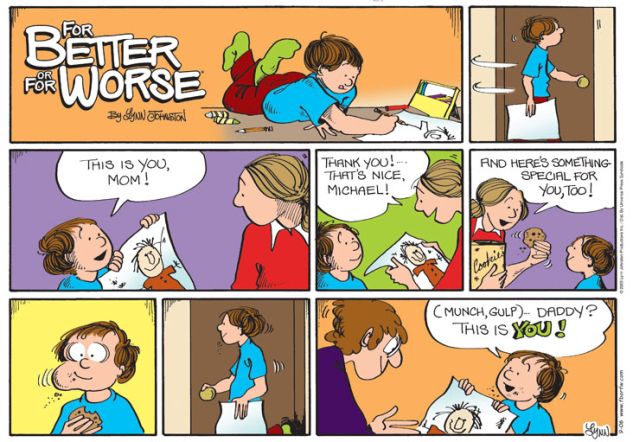
I spend a lot of time thinking about incentives, so I chuckled when I saw today’s For Better or for Worse:
Today, Bob Herbert in the New York Times had a piece on Cameron Todd Willingham, a man executed by lethal injection for the arson murder of his children. Analysis published on August 17, 2009 by Dr Craig Beyler concluded:
in the end, the only (basis) for the determination of arson … is the burn patterns on the floor of the children’s bedroom, the hallway and the porch interpreted as accelerant spill. None of these determinations have any basis in modern fire science.
and
the state fire marshal who investigated the case and testified against Willingham “seems to be wholly without any realistic understanding of fires.” He said the marshal’s approach seemed to lack “rational reasoning” and he likened it to the practices “of mystics or psychics.”
These are some pretty damning statements.
Now, I am against the death penalty, though I wasn’t always, and I posted the article on Facebook as a textbook example of why I believe the death penalty should be abolished. It garnered a few comments, one of which I want to address in a more comprehensive way.
So let’s spend millions of dollars keeping inmates locked up for life, build new prisons, take care of their health problems, etc rather than run the very slim risk that there may be a mistake?
All eliminating the death penalty does is guarantee that people who commit lesser offenses such as manslaughter and rape will be released after the minimum required sentence (or less) due to overcrowding.
I’ve heard this, and similar arguments many times over the years. In the past, I’ve even said similar things myself. However, these arguments are spurious.
That report, by the way, is from 1999… ten years ago. Many of these nonviolent offenders are in prison for drug-related crimes. Regardless of your opinion of whether or not drugs should be legalized, drug abuse is a medical problem, not a criminal justice problem. As such, it should be dealt with by the healthcare system, not the criminal justice system. Indeed, in any graduate-level mental health program, a significant portion of the curriculum is spent on substance abuse and its treatment. In fact, the federal government itself recognizes this, as it has quite a few openings for substance abuse experts.
There’s plenty of room to improve our criminal justice system from redesigning prisons to reforming the law itself to rethinking how we imprison people instead of just the “why”. Looking back at history offers some lessons as well (long-term imprisonment as a concept is only 200 years old (PPT)). Continuing to execute individuals, and justifying it using counterfactual ideas like “cost savings” doesn’t make sense. If we could reform our criminal justice system to the point where executing one more person made fiscal sense, then we will have made significant headway in criminal justice policy in general. And I would go so far as to argue if we ever get to that point, we won’t need to execute people at all because there won’t be any crimes committed that justify execution.
But of course, we’re nowhere near that point, so it’d be purely a game of “what-if”.
Some numbers:
You’re not going to save the system much (if any) money even if you executed all of these prisoners tomorrow.
Going further, the argument seems to be one of ideology: having an opinion and working backwards to justify it rather than letting the evidence guide one to a logical conclusion — even if it is a conclusion that one would otherwise not prefer. Speaking for myself, I have no problem with the concept of putting someone to death, though I could never do it myself. I’m apathetic about the death penalty as an institution, but what gets me going is the possibility of error. If there is a chance that an innocent person could be put to death, the whys and hows of execution are irrelevant. Life in prison is reversable. Execution is not; ergo we don’t kill people. Moral arguments over the right-ness or wrong-ness of killing someone cease to matter.
There are too many possible points of failure. Arguing that we should lower the costs of execution, by streamlining the appeals process while still doing “due justice” to satisfy some moral compunction reeks of trying to alter the world to conform to what one would prefer rather than making policy based on reality.
I have no patience for this kind of thinking.
Other links of interest:
I read an article last night by Michael Nielsen entitled “Is scientific publishing about to be disrupted?” It was probably one of the best articles I’ve read in at least a month. This morning I woke up earlier than expected, and I decided to check out the author’s background, and suddenly it made sense that I was impressed with the content. Fortunately (unfortunately?) he linked to a bunch of other stuff he’s written, and I found myself popping open new browser tabs as though I were browsing Wikipedia.
This led to a great deal of copying and pasting. 34, two-column, 10pt, 4×0.5″ margin pages later, I have a whole pile of reading material. (I read offline because my attention span whilst on the computer isn’t what it needs to be for longer, denser pieces.) I’ve worked my way through a great deal of it, and I find myself wishing I had stuck with Computer Science a while longer.
In any event, here’s the list. Enjoy.
The last two aren’t written by Nielsen, but they’re worth reading, especially if you’re interested in open science.
Life imitates art or art imitates life?
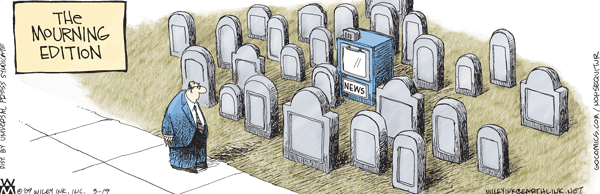
From yesterday’s Big Picture recession-themed photoessay (direct link):

Came across this video on YouTube, and thought it was worth sharing:
The always-excellent Big Picture blog from the Boston Globe has a Lantern Festival photoessay that’s worth checking out, which also covers the unfortunate fire at the Mandarin Oriental Hotel that overshadowed this year’s celebration.
A new twist on children-as-social-insurance. Today’s Stone Soup:

Sandwich generation indeed…
—
This reminded me of some fascinating information from the Gates Foundation. In his first annual letter, Bill wrote that better health is linked with smaller families, so as the overall health of an impoverished region gets better, overpopulation has a long-run tendency to decline, so Malthusian objections aren’t applicable. Women don’t have to have as many babies to ensure that some survive:
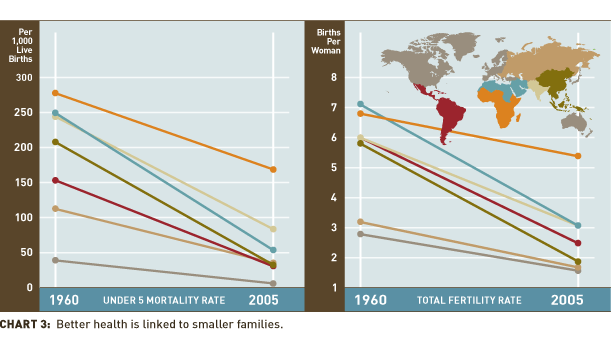
The entire letter is worth reading (PDF). The Gates Foundation is doing some interesting work, and I really like their emphasis on measuring results. I look forward to the day that measurement is politically acceptable and expected in American society. Especially in places like public schools.
Darwin’s 200th birthday is this week, and Harvard is having a Darwin Day on Thursday which I will (alas!) be unable to make it to. (Just like I was unable to make it to the last Harry Potter book launch in the Square. I have rotten luck like that.)
The NYTimes has some great coverage of Darwin this week in their science section, both as a man and as a scientist. His story is one that is tragically ironic. A Christian who struggled with the ramifications of his discoveries, yet a man who is today reviled by many of those who share his core faith.
John Whitfield has been blogging the Origins as a run up to Darwin Day. An intriguing idea… I wonder how many biologists haven’t read it? I haven’t read it, but I’m not a biologist, and it is on my list. First off is Dawkins’ The Ancestor’s Tale which is currently sitting on my bookshelf. (Speaking of which, now that the Kindle 2 is out, I could probably keep most of my collection in digital format with me much like I have virtually all of my music on my iPod…)
My favorite article of the bunch, so far. Darwinism Must Die So That Evolution May Live:
Science has marched on. But evolution can seem uniquely stuck on its founder. We don’t call astronomy Copernicism, nor gravity Newtonism. “Darwinism” implies an ideology adhering to one man’s dictates, like Marxism. And “isms” (capitalism, Catholicism, racism) are not science. “Darwinism” implies that biological scientists “believe in” Darwin’s “theory.” It’s as if, since 1860, scientists have just ditto-headed Darwin rather than challenging and testing his ideas, or adding vast new knowledge.
Using phrases like “Darwinian selection” or “Darwinian evolution” implies there must be another kind of evolution at work, a process that can be described with another adjective. For instance, “Newtonian physics” distinguishes the mechanical physics Newton explored from subatomic quantum physics. So “Darwinian evolution” raises a question: What’s the other evolution?
Almost everything we understand about evolution came after Darwin, not from him. He knew nothing of heredity or genetics, both crucial to evolution. Evolution wasn’t even Darwin’s idea.
Darwin’s grandfather Erasmus believed life evolved from a single ancestor. “Shall we conjecture that one and the same kind of living filaments is and has been the cause of all organic life?” he wrote in “Zoonomia” in 1794. He just couldn’t figure out how.
Gregor Mendel, an Austrian monk, discovered that in pea plants inheritance of individual traits followed patterns. Superiors burned his papers posthumously in 1884. Not until Mendel’s rediscovered “genetics” met Darwin’s natural selection in the “modern synthesis” of the 1920s did science take a giant step toward understanding evolutionary mechanics. Rosalind Franklin, James Watson and Francis Crick bestowed the next leap: DNA, the structure and mechanism of variation and inheritance.
Don’t miss the Q&A beginning around 24:00.
A friend told me she disagreed with my post the other day on big media’s relationship with YouTube:
I totally disagree with your media article. NBC gets revenue from Google for sharing their content–this will never happen in a way that works for both. NBC should be allowed to host the shows on their own site with the ads they would like to include on their own site.
I think YouTube needs to take off all its questionable content. Just because people have trouble enforcing certain rules doesn’t mean that there is no reason for intellectual property protection. YouTube makes most of its revenue off of encouraging people to rip things off of other sites. It doesn’t produce anything, and, as a platform, I don’t even like it that much.
It struck me that I didn’t flesh out my argument on what YouTube is good for very well — mostly because it wasn’t the point of my post — but that I probably should. First off, a couple of things.
NBC can do whatever it likes with its content. It owns it, and should be allowed to do whatever it wants with it. I think it’s in their best interest, however, to leverage YouTube rather than fight it wholesale. (The same holds true for the music industry.)
In fact, NBC does host their own content at NBC.com and in other places (Hulu). You can watch whole episodes of e.g. Heroes and many other shows for free, on demand. I think they’ve done a remarkably good job in leveraging the excitement of the fans as well as doing some interesting stuff by embracing other kinds of media, most notably the Heroes webcomic.
It terms of showing TV shows that have actors and scripts and story arcs, YouTube isn’t the best platform. Hulu is preferable for a number of reasons:
Where Hulu does NOT shine is permanence. This is driven largely by content deals with networks, so Hulu isn’t to blame, here. It is frustrating to embed a Hulu clip in something like a blog post and have it be expired in two weeks. This breeds ill will towards Hulu, even though the network is the real culprit.
YouTube’s strengths are:
If I were NBC, would I want Heroes on YouTube? Not in its entirety, no. I would certainly have some HD trailers and teasers for the various episodes available, and if viewers wanted to upload their favorite short scenes and mashups, I wouldn’t want them deleted. It’s all good publicity for the brand and it costs me nothing. (And indeed NBC is pretty lenient, as far as I can see.)
I would use these clips to drive people to the homepage for Heroes at NBC.com, and/or on Hulu.
But it was the news program format that I was mainly concerned with the other day. YouTube does shine when it comes to interviews with public figures. In this respect, news organizations almost perform a public service, but the problem with their ownership of their content means that if a politician does something boneheaded, it’s largely forgotten in a relatively short time as the content is locked in a media company’s footage archives, relegating it to little more than ephemeral conversation for the public’s needs and wants.
Of course, it’s not NBC’s job to do what’s in the public’s best interest, it is their fiduciary duty to maximize shareholder value. However in this case, I believe that these goals are one and the same. After all, we can’t be sure that The Daily Show will be around forever…
YouTube is a perfect environment for these single-issue clips thanks to its ubiquity and permanence. If a content owner like NBC wants to keep whole episodes for their own web property, that’s fine. But I think they should allow (and promote) uploading of shorter clips, like the segments from Meet the Press that I lamented the other day. Use these clips to drive people to NBC.com. Your brand gets free publicity, the public benefits, and it has cost you nothing.
If CBS has filed copyright infringement notice with YouTube, would most of us have seen the first-hand footage of the trainwreck that was Sarah Palin this past election season? Probably not — the number of folks in my generation that watch news programs on TV is vanishingly small…
A friend updated their Facebook status to lament overpaid athletes relative to seemingly more important things like… saving lives. It seemed an opportune moment to flesh out the economics of athletes’ paychecks.
It’s true, athletes may play a kid’s game, but bear in mind that no matter the sport, they are employing millions of people both directly and indirectly. The people in the back offices, the groundskeepers, the people that work for the TV networks, the people that work for the advertisers, etc. So while your average athlete may bring in $3-500K/yr (not everyone’s a superstar), they’re generating billions in economic wealth that’s spread over many, many working people like you and I.
The other thing to consider is that health care is a cost, not a wealth-driver in the macroeconomy. Buying health services is always an inferior choice to spending your money in another way, unless you need that service. (This is one of the reasons I feel that healthcare shouldn’t count as a positive input into GDP calculation.)
So anyway, I can understand the frustration associated with high salaries for athletes, because what they do at a fundamental level is so trivial. But I can also understand why athletes are paid the way they are. From a narrow point of view, their contribution to society is very small. But from a higher-level view, their contribution is much greater than we often given them credit for:
Who contributes “more” to society is less clear from PoV #2. From a low-level one-on-one perspective, the physician saving a life does. But from society’s point of view, #2 is obviously the winner, outliers (maybe) excepted.
I don’t say any of this to marginalize those who work in the healthcare or teaching professions. It is not my intent to diminish what they do in any way. One of the problems associated with teaching and being a physician is that it’s so hard to measure their long-run economic impact on a society because the gains may take a lifetime to measure in the case of early childhood education, or may be represented as hours of productivity saved in the case of a medical intervention.
It’s quite a bit easier to measure TV viewership, sponsorship monies, and whether or not your stadium is full on game day than it is to measure lifecycle productivity gains.
We could get normative and make judgment calls about what should happen and how people should be paid based on the inherent value of the job they do, but these are meaningless arguments because in order to effect any of them, we’d have to shift society’s values. Everything in our economy is a byproduct of consumer priorities: where consumers choose to spend their scarce resources (money). Salaries are a byproduct of these consumer choices, and nowhere is this more pronounced than in the entertainment business.